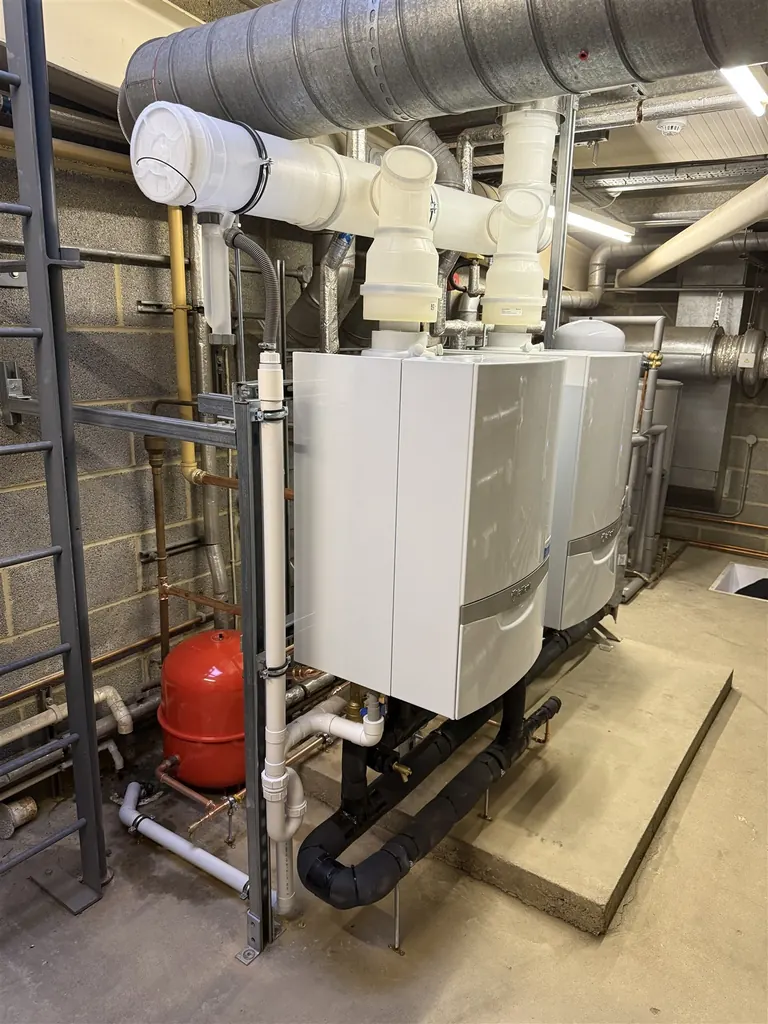
Start with what the building needs now.
A like-for-like replacement can miss changes in occupancy, extensions or troublesome parts of the existing system. Before selecting equipment, Oxyplumb Commercial can help you establish the heating and hot-water requirements, available space and practical constraints.
- Bring equipment lists, drawings and recent service records if available.
- Identify important rooms, operating hours and periods when work would be least disruptive.
- Tell us about recurring faults, cold areas, slow hot-water recovery and future changes in use.
- Agree who is responsible for design, building-control matters, specialist assessments and enabling work.
Compare the scope, not just the boiler price.
| Approach | Potential benefit | Trade-off to discuss |
|---|---|---|
| Targeted repair or controls work | Sound equipment with an identifiable problem | Likely remaining life and whether the fault will recur |
| Phased replacement | Investment or disruption needs spreading out | Temporary compatibility, sequencing and repeated enabling costs |
| Coordinated plant-room renewal | Several ageing components or a changed building load | Capital budget, downtime, system design and future maintenance |
A useful quotation identifies the retained equipment as clearly as the new equipment. We’ll discuss pumps, controls, flues, gas supply, water treatment, insulation and access. If an item sits outside our agreed scope, it should be clear who is taking care of it.
Explore commercial boiler installation and manufacturer ranges, or our commercial hot-water options.
Plan the changeover before the first isolation.
- Agree the sequence. Identify which heating and hot-water services each stage affects.
- Prepare the site. Confirm access, lifting routes, electrical works and any specialist surveys.
- Set realistic interruptions. Discuss temporary arrangements where required; do not assume they are included.
- Commission and demonstrate. Record the agreed checks, explain controls and hand over equipment information.
Schools, care settings and workplaces each have different constraints. Our LTI Milton Park and Mulberry Bush School projects show completed work in real occupied settings.
Make the new system easier to look after.
Ask for a clear equipment schedule, commissioning records relevant to the scope, operating instructions and maintenance requirements. The person who changes the time schedule should understand the controls; the next engineer should be able to identify the plant.
We can discuss planned maintenance once the asset list and responsibilities are agreed. For the wider project, see our compliance planning guide. Energy performance depends on design and use, not the boiler badge alone.