Understand the bill before replacing the equipment.
High bills can come from long operating hours, unnecessary heating of unused areas, distribution losses or equipment condition. We’ll ask for consumption in kWh, tariff details and an explanation of how the building is used. A bill in pounds alone cannot separate a price rise from extra energy use.
- Compare periods with similar occupancy and take weather into account.
- Check time schedules, holiday settings and rooms that are heated unnecessarily.
- Look at controls, insulation and maintenance alongside replacement equipment.
- Keep the building’s ventilation, comfort and water-safety requirements intact.
The Carbon Trust: business energy-saving guide (opens in a new tab) is a useful starting point for a business energy review. Oxyplumb Commercial can help you decide which questions are worth investigating at your premises.
Which improvements are worth investigating?
| Area | Questions to ask | What affects the result |
|---|---|---|
| Schedules and controls | Is heating running when the building is empty? | Operating hours, overrides and zone control |
| System condition | Are pumps, emitters and valves working as intended? | Maintenance, balancing and distribution losses |
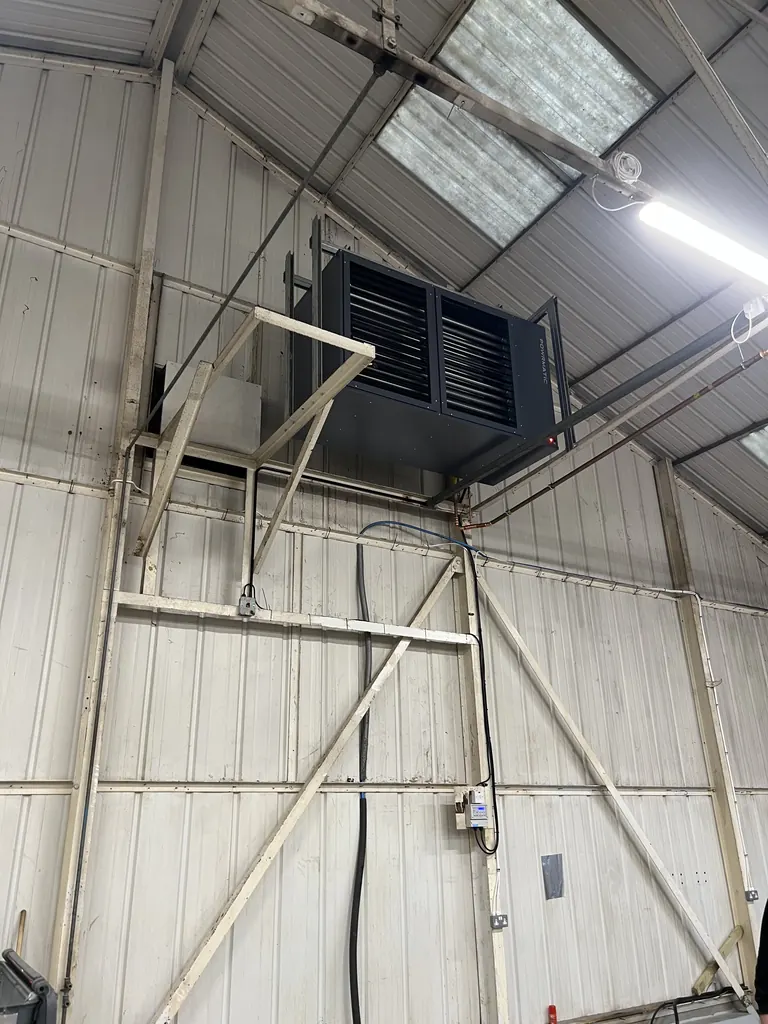
| High-space heating | Is warmth collecting above the occupied zone? | Roof height, doors and air circulation |
| Equipment replacement | Can new equipment meet the load more effectively? | Sizing, operating temperatures and seasonal performance |
A transparent example—not a savings promise.
This hypothetical comparison keeps annual useful heat at 180,000kWh. It assumes seasonal efficiency improves from 75% to 90%, with fuel priced at 8p/kWh. These are teaching assumptions, not measurements of your system or guarantees for a particular product.
| Calculation | Assumed existing | Assumed improved |
|---|---|---|
| Useful heat ÷ seasonal efficiency | 180,000 ÷ 0.75 | 180,000 ÷ 0.90 |
| Fuel input | 240,000kWh | 200,000kWh |
| Fuel cost at £0.08/kWh | £19,200 | £16,000 |
Illustrative difference: 40,000kWh and £3,200 a year, or 16.7% of the starting fuel use. It is not a 15% saving simply because efficiency rose by 15 percentage points.
The example excludes installation cost, electricity changes, standing charges, VAT, finance, maintenance and changes in weather or use. Any payback assessment needs those costs and credible site-specific performance assumptions. Different fuel tariffs cannot be compared using this single-fuel example.
Build a proposal you can make a decision on.
With Oxyplumb Commercial, the next step can be a commercial energy review, a controls discussion or an assessment for replacement. We’ll explain what information is missing and which improvements can be considered together.
For warehouses, explore warm-air heating and circulation options. For wider changes, see plant-room upgrade planning. Never reduce hot-water safety temperatures simply to reproduce an energy-saving example.