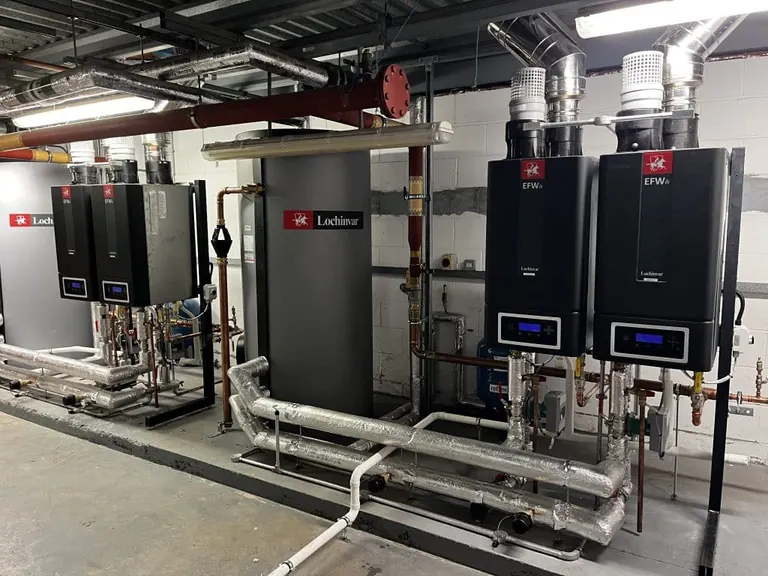
Four different questions to ask.
| Question | What it tells us | Useful information |
|---|---|---|
| Is there enough stored hot water? | How the system covers a short peak | Storage capacity, outlet use and peak duration |
| Does it recover quickly enough? | How fast heat is put back after draw-off | Appliance output, coil performance and demand pattern |
| Is the pressure adequate under load? | Whether pressure is retained when outlets run | Dynamic measurements at relevant points |
| Is enough water arriving? | Whether the incoming flow meets the demand | Measured flow, restrictions and simultaneous use |
We can help with commercial hot-water equipment, boosters and accumulators, and the connected plumbing. Choosing these together helps avoid solving one symptom while leaving the underlying restriction.
Compare the whole water system.
Dedicated water heaters and indirect cylinders provide different ways of generating and storing hot water. An accumulator is not a hot-water cylinder, and a heating circulation pump is not a cold-water booster. We’ll identify what each component does before recommending a replacement.
| Option | Useful distinction | Check before specification |
|---|---|---|
| Accumulator | Short periods of higher draw-off | Usable volume, available supply pressure and refill time |
| Variable-speed booster set | Demand that changes across several outlets | Measured duty point, controls, noise and electrical supply |
| Break tank and booster arrangement | Where storage and supply separation are required by design | Water quality, turnover, backflow protection and plant space |
The Grundfos constant-pressure systems (opens in a new tab) and Stuart Turner Mainsboost (opens in a new tab) information illustrate different approaches. Range details are a starting point; suitability still depends on the measured duty and application.
Keep water safety part of the design.
Under the usual temperature-control approach, HSE guidance calls for hot-water storage of at least 60°C, with distribution reaching 50°C within one minute at outlets, or 55°C in healthcare premises. Cold water should be kept below 20°C where possible. Scalding risks need appropriate control, including suitable thermostatic mixing where needed.
These are system-management considerations, not instructions to alter settings yourself. A risk assessment, suitable design and ongoing management remain important. See HSE: hot and cold water systems (opens in a new tab).
A pump inducing demand above 12 litres per minute requires notification to the local water undertaker, whether connected directly or indirectly to the supply. This is not a blanket statement that every boosted system is limited to 12 litres per minute. See Water Regs UK: pump notification (opens in a new tab).
What to send us.
- A short description of the problem, including when it happens.
- Photographs and model details for accessible tanks, cylinders and pumps.
- The number of showers, kitchens or other outlets likely to operate together.
- Any water-system assessment, drawings or monitoring records available.
We’ll agree whether measurements or a site assessment are needed before preparing the proposal. For unvented hot-water work, safety and discharge arrangements must also be considered; Approved Document G: hot-water safety (opens in a new tab) covers the relevant England guidance.